Dubai’s air conditioners work harder than almost anywhere else in the world. Between the heat, the humidity and the fine sand that gets into everything, a system that would need servicing once a year in a milder climate often needs attention two or three times a year here. Get the schedule wrong and you pay for it twice: once in a higher DEWA bill, and again when a part fails earlier than it should.
This guide covers how often to service each type of system, what a proper service includes, and the signs that mean you shouldn’t wait for the calendar.
The short answer
For most homes, twice a year covers it: once before the peak summer heat, and once after it eases off. If your AC runs almost continuously from June to September, which is normal in Dubai, that load alone justifies a check-up on each side of the hot season.
| System type | Typical schedule | Why |
|---|---|---|
| Split units (bedrooms, living rooms) | Every 4–6 months | Dust clogs the filter and coil fastest in rooms with more airflow and foot traffic |
| Ducted and central systems | Every 6 months | Longer duct runs collect dust gradually; harder to inspect without a technician |
| FCUs on district cooling (chilled water) | Every 6 months | Valves, motors and thermostats need checking even though there’s no compressor to service |
| Rental or AMC-covered properties | As scheduled in your contract, usually 2–4 visits/yr | Spreads servicing evenly and catches issues before tenants report them |
Why Dubai’s climate changes the rules
Three local factors push the schedule tighter than manufacturer guidelines written for temperate countries:
- Dust and sand. Even with windows closed, fine dust works into filters and coils faster here than in most climates, especially near construction sites or during shamal winds.
- Run time. Many homes run their AC 16–24 hours a day for six to eight months. That’s several times the annual run time of a typical European system.
- Outdoor heat load. Compressors and outdoor coils work harder to reject heat into 40°C-plus air, which stresses components that a cooler climate wouldn’t test as hard.
DEWA’s own guidance to set thermostats to 24°C exists partly because of this: each degree cooler than that adds roughly 5% to your cooling energy use, and a dirty, unserviced system can lose several degrees of efficiency on top of that.
What a full AC service should include
Not all “services” are equal. A proper visit should cover:
- Filters removed, washed and dried, or replaced if damaged
- Evaporator coil and drain tray cleaned
- Drain line flushed, to prevent the leaks that follow a blocked drain
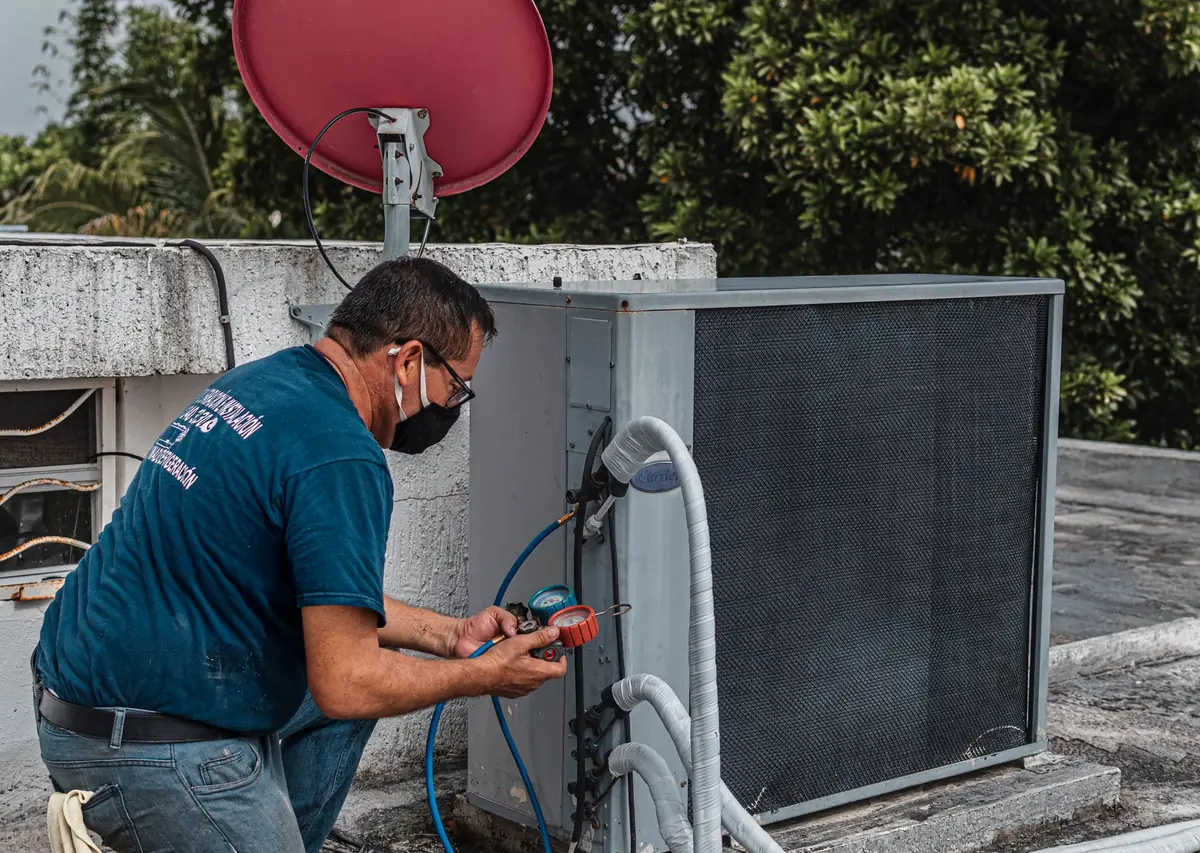
- Refrigerant pressure and running amps checked against the manufacturer’s spec
- Thermostat and remote tested
- A before-and-after reading of the air coming off the unit
If a visit skips most of these and is really just a quick filter wipe, it’s not doing much for efficiency or lifespan, even if it’s billed as a “service”.
Signs you shouldn’t wait for the next scheduled visit
Between services, a handful of warning signs mean it’s worth calling sooner rather than later:
- Weaker airflow or warmer air than usual, even on the coldest setting
- A musty smell when the unit starts, which often points to a dirty coil or drain
- Water dripping from the indoor unit, usually a blocked drain line
- Unusual noise: rattling, buzzing or clicking that wasn’t there before
- A DEWA bill that’s risen without an obvious reason
Any of these are worth a look before the next scheduled service. See our guide on why an AC stops cooling for a closer look at the most common causes.
Deep cleans vs routine servicing
A routine service cleans what’s reachable without dismantling the unit. A deep coil clean, recommended roughly once a year or when airflow has clearly dropped, removes the indoor unit’s casing to wash the coil and blower wheel directly. It costs more and takes longer, but it restores airflow that a routine service can’t reach. Our AC service cost guide breaks down the price difference.
Keeping to a schedule without the admin
The easiest way to stay on schedule is to stop relying on memory. Our annual maintenance contracts build the right number of visits into the year for your system type, so the servicing happens whether or not you remember to book it, and you get priority during the summer rush when everyone else is calling at once.
What happens if you skip services altogether
Putting off servicing doesn’t just risk a breakdown on the hottest day of the year. A unit that’s never cleaned draws more current to move the same amount of air, which shows up as a steadily climbing DEWA bill long before the AC actually fails. The compressor, which is the most expensive part to replace, also runs hotter and under more strain when the coils are dirty, so a problem that a routine service would have caught early can turn into a repair bill, or a replacement, many times that size.
There’s a tenancy angle too. If you rent, a service history is useful evidence if a unit fails and there’s a dispute over whether it was fair wear and tear or neglect. Our guide on who pays for maintenance, landlord or tenant covers how that responsibility is usually split under Dubai law.
If your AC is overdue for a check, or you’d rather set up a schedule and stop thinking about it, book a visit or send us a message on WhatsApp. We’ll confirm the price before any work starts.